

Langzeitunterkunft in Wolfsburg für Monteure
A project goes long in Wolfsburg, the headcount changes twice, and suddenly “we’ll just book a few rooms” turns into daily friction: keys, parking, noise, different standards from room to room, and invoices that do not match procurement rules. If you are coordinating a team for the Volkswagen area or nearby industrial sites, the accommodation decision is not hospitality - it is operational control.
This article is written for the people who carry that responsibility: project managers, site supervisors, travel coordinators, and procurement teams. The goal is simple - help you choose a langzeitunterkunft wolfsburg für monteure that keeps teams productive and makes the booking, access, and billing side predictable.
What “long-stay” really means for Monteure
In this segment, long-stay is not a vacation monthly rental. It usually starts when a booking passes the first workweek and the team stops tolerating improvised setups. For many companies, the practical long-stay band is about 4 days to 6 months, with the sweet spot at multi-week assignments where kitchens, laundry, and stable Wi‑Fi matter as much as the bed.
The trade-off is clear: the longer the stay, the less your team can “work around” issues. A missing parking spot is a daily delay. A weak internet connection becomes a ticket backlog. A complicated check-in becomes a late-night phone chain. So long-stay is less about price per night and more about removing small operational failures that compound.
The buyer’s checklist: what actually reduces downtime
Most options in Wolfsburg advertise similar basics. The difference is whether those basics are consistent and controllable for a team.
Start with sleep logistics. For project crews, single beds are usually the standard because it reduces conflict and keeps schedules flexible. Then look at the living setup. A full kitchen is not a “nice to have” on a six-week job - it is what prevents teams from burning time and budget on daily meals. Laundry on-site matters for exactly the same reason.
Connectivity is often underestimated until it fails. Fast, stable Wi‑Fi is not only for streaming - it supports shift planning, reporting, and remote toolbox talks. If you have specialists who need to join video calls, internet quality is a productivity input.
Parking is its own category in industrial regions. If the team arrives in vans, you want on-site parking that does not require a nightly search or moving vehicles at 6 a.m. The hidden cost of poor parking shows up as late starts, stress, and vehicle risk.
Finally, look for a self-contained setup. Traditional monteurzimmer models are room-based and can work for one person, one week. For teams, shared corridors and mixed occupancy add unpredictability: noise, different standards, and questions around who has access to what. A whole-house model is usually easier to manage because it is your team’s space, every day.
Whole house vs. rooms vs. hotels: which fits which job?
It depends on your project profile.
Room-based monteurzimmer can be cost-attractive for very short stays or when you are placing individual workers with different schedules. The downside is standardization - you may end up with different addresses, different rules, and different quality levels. For procurement, that often means more admin and more follow-up.
Hotels are strong when you need central reception, daily cleaning, and very short-term flexibility. They become less efficient when the assignment stretches: teams miss kitchens and laundry, and room separation makes coordination harder. Parking and breakfast timings can also create friction for early shifts.
A whole-house, corporate accommodation approach is typically strongest for multi-week and multi-month team deployments. You trade the “front desk” for self check-in, and in return you get privacy, predictable living conditions, and better team logistics. The key requirement is that the provider runs it like a business service - with clear processes, support, and VAT-compliant invoicing.
The cost logic: what you are really paying for
Long-stay housing is often compared on nightly rate alone. That is rarely the right metric.
For teams, the useful number is cost per person per night, plus the operational costs you avoid. A whole-house rate can look higher than a single monteurzimmer room until you divide by the number of beds and factor in meals, transport, and admin time.
Kitchen access shifts spending from restaurants to groceries. Laundry prevents repeated trips to laundromats. On-site parking reduces taxi usage and prevents parking fines. Stable Wi‑Fi reduces reliance on mobile hotspots and avoids delays in reporting.
There are also procurement costs: chasing missing invoices, correcting addresses, or handling deposits inconsistently can cost more than the difference between two accommodations. If your internal process requires VAT invoices, a clear billing cadence, and one contract partner, choose a provider that supports that from day one.
Access and support: the difference between “available” and “operational”
Long-stay bookings often start outside office hours. Teams arrive after shifts, traffic, or late material deliveries. That is why 24/7 self check-in is not a gimmick - it is risk reduction.
Equally important is what happens after check-in. If a Smart TV fails, it is not critical. If a lock battery dies, the project loses time. If Wi‑Fi drops, reporting stops. A professional setup provides a clear point of contact and a response process that does not depend on “the host is on vacation.”
Ask how support works, not whether support exists. Who answers? How are issues logged? What is the expected response time? Those answers are usually more telling than any amenity list.
Occupant changes: plan for reality, not for the booking form
On longer assignments, headcount changes. Someone rotates out, a specialist joins for ten days, a second shift starts.
Accommodation that cannot handle occupant changes cleanly becomes an admin problem. You want clear rules for how many people are allowed, how names are documented (for safety and compliance), and how key or code access is managed when someone leaves. For teams, the goal is simple: no access chaos, no unclear liability, no confusion about who is supposed to be in the unit.
If your projects are dynamic, bring that up before booking. A provider that works with corporate teams should be comfortable with planned changes as long as the process is transparent.
Location matters in Wolfsburg - but not in the tourist sense
For industrial deployments, “good location” means predictable travel time to the plant or site and easy logistics for vans. Being five minutes closer is less valuable than being reliably accessible with parking.
Also consider what your team needs after shift. Grocery access matters because it supports kitchen use. A quiet residential setting can matter for night-shift sleep. Outdoor space is not a luxury if the team is staying for months - it is part of living without feeling trapped in a room.
What a purpose-built setup looks like for project teams
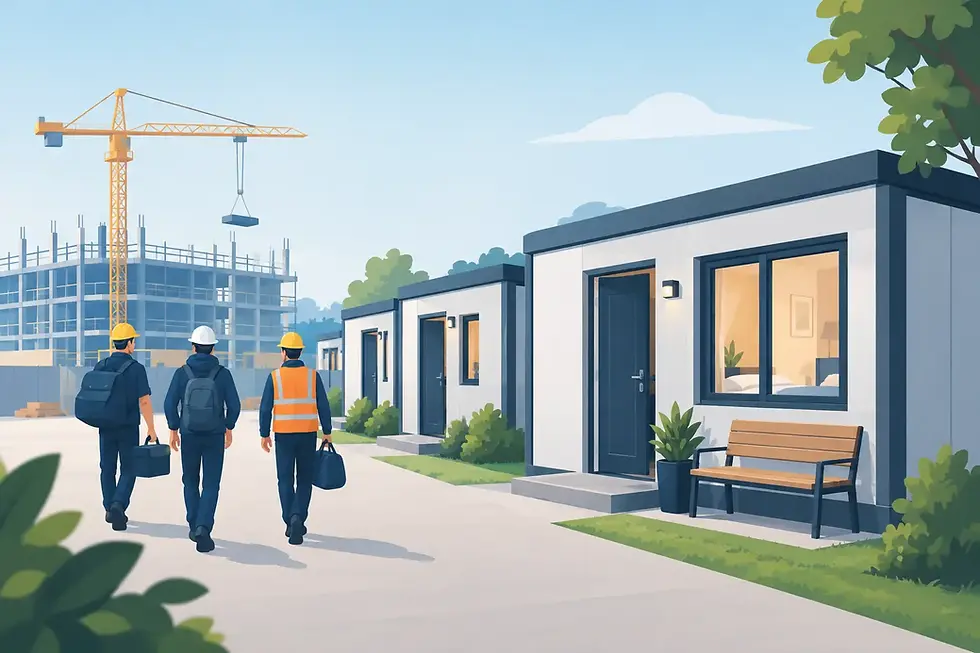
A corporate-ready long-stay house is usually newly built or recently renovated, fully furnished, and designed for repeat use. It has single beds, a full kitchen with real cooking capability, laundry equipment, fast Wi‑Fi, Smart TVs, and on-site parking. It is cleaned and reset to a defined standard, with linens and towels handled professionally.
The operational layer is what turns “a nice house” into a procurement-friendly service: self check-in, a dedicated contact, VAT invoices, and long-stay pricing aligned with project durations.
One example of this whole-house model in the Wolfsburg area is WORKATION Wolfsburg, which rents newly built, fully equipped houses (Haus A, Haus B, Haus C) designed for teams up to seven - positioned explicitly as “Ganzes Haus statt Zimmer” for multi-week and multi-month assignments.
Practical booking workflow for coordinators
To reduce back-and-forth, treat the booking like any other project resource request.
First, define the basics: start date, expected end date range, team size, and whether shifts require quiet hours. Then clarify vehicle needs: number of vans and whether trailers are involved. Next, confirm billing requirements: VAT invoice, company address, purchase order reference, and whether you need a single invoice or periodic billing.
Before you confirm, ask two operational questions that prevent most surprises: how self check-in works in detail, and what the process is for occupant changes during the stay. If the answers are clear, you will usually have a smooth deployment.
FAQs that procurement and site leads actually ask
Do we get VAT-compliant invoices for accounting?
For corporate bookings, you should expect an invoice with VAT and clear service dates. If your internal process requires PO numbers or cost center references, clarify that upfront so invoices match your system.
Can our team check in late at night or on weekends?
If your schedule is unpredictable, prioritize 24/7 self check-in. Confirm whether access is via code, key safe, or digital lock and how many access methods are provided for a group.
What is the best option for 5-7 people on one project?
For that team size, a whole-house setup is often the cleanest operationally because everyone is at one address with one kitchen, one laundry setup, and consistent standards. Rooms can work, but you may trade savings for coordination effort.
Can we extend the stay if the project timeline shifts?
Extensions depend on availability. The earlier you communicate the likely range, the easier it is for the provider to hold capacity or propose a second house if needed.
What if we need to swap occupants mid-stay?
This is common. Ask for a defined process: how names are updated, how access is changed, and what rules apply to maximum occupancy. Clear rules protect both sides and prevent access issues.
A good long-stay setup in Wolfsburg is the one you stop thinking about after day one. When the team sleeps well, parks easily, cooks, washes workwear, and gets inside without calls and confusion, you have achieved the real goal: fewer interruptions, fewer admin loops, and more predictable project delivery.


Kommentare